


The Pacific Blue Shipping Partnership (PBSP)

June 12 2026: PBSP Charter Signed in Majuro, Marshall Islands
PBSP-Charter-Signed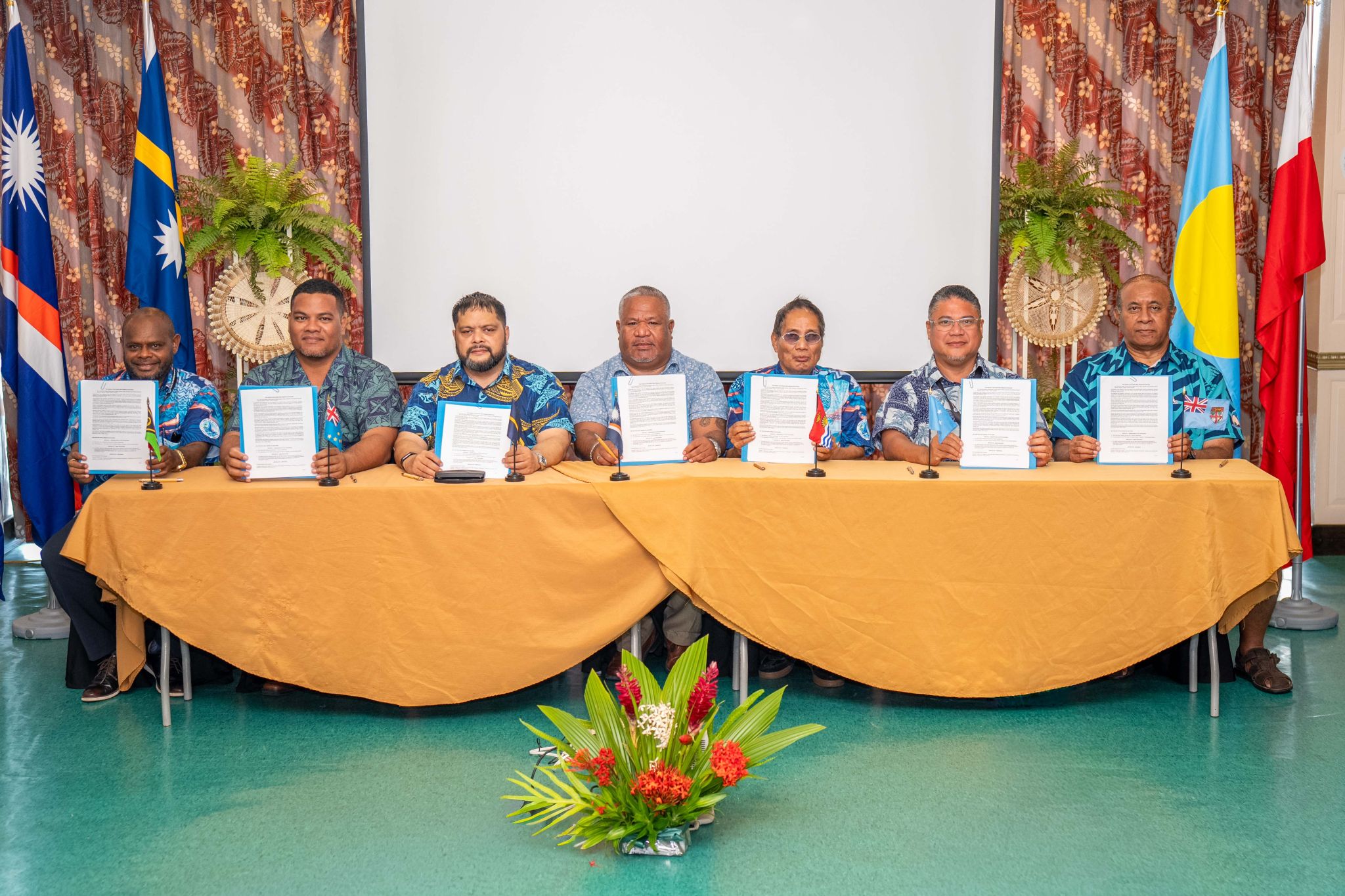
Ministers from seven Pacific Island countries following the signing of the Pacific Blue Shipping Partnership Charter, marking a sigsignificant milestone in country-led maritime planning and sustainable shipping development.
From left: Minister for Fisheries, Ocean and Marine, Vanuatu, Honorable Norris Jack Kalmet; Minister for Transport, Energy & Tourism, Tuvalu, Honorable Simon Kofe; Deputy Minister for Foreign Affairs & Trade, Naoero, Honorable Russ Joseph Kun; Minister for Transportation, Communication and Information Technology, Republic of Marshall Islands, Honorable Hilton Kendall; Minister for Information, Communication and Transport, Kiribati, Honorable Alexander Teabo; Chief of Staff Pohnpei State; Patterson K. Shed; Minister for Public Works, Transport and Meteorological Services, Fiji, Honorable Ro Filipe Tuisawau
PBSP Ministerial Outcomes Document
PBSP-Ministerial-Outcome-StatementApril 2026 Presentation: What are the maritime technologies needed to deliver an equitable transition at scale?
MCST prepares new narratives for The Pacific Blue Shipping Partnership (PBSP)
Key Introductory Resources:
- PBSP in 14 slides
- PBSP Working Paper #4 – Governance, Financing and Technology Transition Narratives
As Pacific high ambition pressure at IMO for a paradigm shift for international shipping decarbonization builds and we inch closer to a real price on shipping emissions, we turn back to how to organize a parallel shift for our domestic fleets.
In our latest technical working paper, MCST suggests alternative narratives for the governance, financing and technology transition pathways for the Pacific Blue Shipping Partnership.
The speed and scale of transition required to implement our country’s NDC’s domestic maritime targets are unprecedented. It demands a complete revolution in technology and a paradigm shift in fleet management and operations as well as the financial investment and program delivery away from existing structures. A dedicated bespoke solution is required.
Central to PBSP’s design is the need for a country-owned and -driven program – Our research considers a collective country approach with governance via a Ministerial Council of participating countries the most appropriate and efficient structure.
In essence PBSP is a formal agreement between ten Pacific states to:
- set a common objective via NDCs for their domestic shipping transition
- collaborate on setting national strategic policy and project priorities through National Action Plans to best advantage the collective Partnership
- agree to coordinate external no-regrets climate finance investment as a collective portfolio to best advantage the collective Partnership
- collaborate to build long-term in-country capacity and institutional strengthening to underpin the domestic maritime transition across the sector
What is the goal?
The PBSP is an ambitious country-driven initiative for a large-scale climate finance investment to catalyse a multi-country transition to sustainable, resilient, and low carbon shipping.
The decarbonisation targets for domestic shipping are:
- Zero emissions by 2050
- 40% reduction by 2030 (conditional on access to appropriate finance)
The Pacific Nations supporting the PBSP are:
- Fiji
- Federated States of Micronesia
- Kiribati
- Nauru
- Palau
- Republic of the Marshall Islands (RMI)
- Solomon Islands
- Tonga
- Tuvalu
- Vanuatu
How did the PBSP emerge within the Pacific?
The PBSP was first signalled by Fiji PM Bainimarama and RMI President Hilda Heine at the One Planet Summit in New York in 2018. In a dedicated side event at the Climate Action Pacific Partnership (CAPP) in Suva in 2019 the PBSP was confirmed, with Ministers and government representatives of Vanuatu, Tuvalu, Solomon Islands, Tonga, Kiribati offering their support. Fiji and RMI now call for further Pacific Island countries and key international partners to join this initiative.
Initially in 2019 PBSP sought a climate finance package of USD500m to fund decarbonisation of domestic shipping and related infrastructure in 5-6 Pacific Island countries. This proposal builds on the efforts previously endorsed by the Pacific Regional Energy and Transport Ministers in April 2017, by the 18th Micronesian Presidents’ Summit in February 2018 and the Pacific Island Transport Forum in November 2018.

PBSP Technical Summary
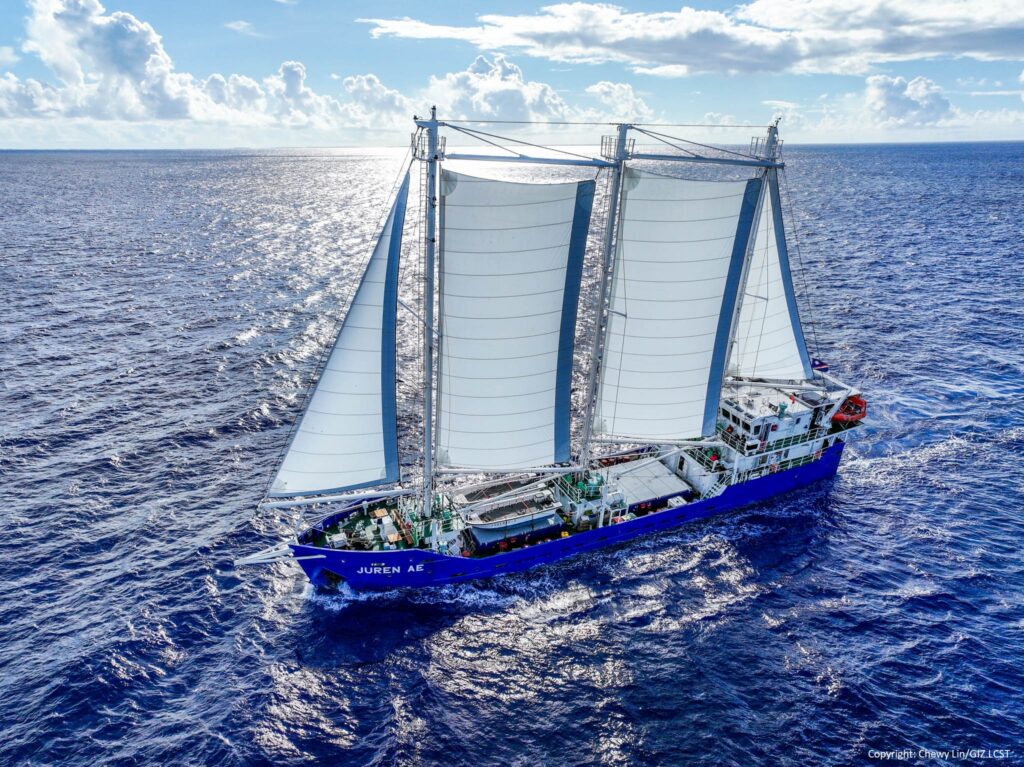
Alongside multiple regional and international partners, MCST is providing research and technical support to the project.
Current evidence highlights the significant and enduring potential benefits (social, economic, and environmental) of a rapid transition to sustainable, resilient and low-carbon sea transport in PICs. Climate change is an urgent threat to the maritime transport sector (and sustainable development generally), which can be addressed in part through efforts to decarbonise and adapt the sector in accordance with the 2015 Paris Agreement.
PICs have been catalytic to the work of the International Maritime Organisation (IMO), which in 2023 unanimously agreed a strategy for full decarbonisation of shipping by 2050. This target is a positive step but remains inconsistent with the level of ambition required to limit climate change to below 1.5°C or even 2°C.
Fiji and RMI are asking the PBSP Member States to commit to a common emissions reduction goal for Pacific shipping of 40% by 2030, and full decarbonisation by 2050. These targets are conditional on access to appropriate finance.
The need for sustainable shipping in the Pacific
Transportation and mobility are cross-cutting issues central to the sustainable development of PICs. Within the region, shipping is essential to almost all forms of trade, domestic economic activity and societal connectivity, especially for the most remote and climate-vulnerable communities. Despite the necessity of shipping, domestic ferries and inter-PIC transport vessels are commonly old, fuel inefficient and unsafe.
PICs are also precariously dependent on imported fossil fuels raising critical issues of fuel price vulnerability and security of supply. A transformation to more appropriate, clean and affordable shipping at both domestic and international levels and at scale and speed across the region, requires substantive and immediate investment.
In comparison to other major economic sectors, investment in the sustainable development (including climate change mitigation and adaptation) of sea transport for PICs has been extremely limited to date.
A ‘once-in-a-generation’ financing opportunity
Initially PBSP sought a climate finance package of USD500m to fund decarbonisation of domestic shipping and related infrastructure in 5-6 Pacific Island countries. The USD 2 billion invested into the electricity sector under the Pacific Energy Summits since 2012 provides a precedent for such international cooperation, whereas international climate finance offers an unprecedented opportunity. Since 2019 costs required to implement a maritime decarbonisation transition have increased significantly.
Large-scale financial investment in sustainable sea transport will require input from diverse sources, following a climate finance approach, catalysed in the short and medium term by both bilateral donor assistance, and international guarantees. The PBSP is currently preparing an application to the Green Climate Fund for a demonstration fleet fleet of up to twelve representative low-carbon vessels. This fleet can then be replicated and scaled through an integrated programme portfolio of both grant and revolving loan modalities targeting public and private sectors and all scales of shipping from village to inter-country. The cost of this financing could be significantly reduced by guarantees, grants, or highly concessional instruments supported by development partners.
A climate finance approach for shipping would be consistent with the:
- 2030 Agenda for Sustainable Development
- Paris Agreement on Climate Change
- Regional NDCs
- The SAMOA Pathway
- Framework for Resilient Development in the Pacific
Support for this approach has been well signalled by the UN agencies (UNCTAD, WFP, UNESCO, UNESCAP) and regional agencies including USP, SPC and PIFS (SIS secretariat).
Links & Resources
- De Beuklear et al. (2026). Sailing Through Time: Building Pacific Maritime Resilience
- Nuttall (2024) The deepening climate emergency for Pacific domestic shipping supply chains and what can be done
- PBSP- The Guardian; Pacific Islands Seek 500m Ocean Shipping Zero Carbon
- PBSP CAPP Side Event 2019
- PBSP – Technical Working Paper 1
- PBSP – Technical Working Paper 2
- PBSP – Technical Working Paper 3
- PBSP – Technical Working Paper 4
- Pacific Domestic Maritime Technology Transfer Pathways [Presentation]
- Fiji MITTTC Press Release 10 Nov 2020: PBSP first virtual Ministers Meeting
- Using the Ocean As a Tool for Global Economic Recovery
- Pacific Island domestic shipping emissions abatement measures and technology transition pathways for selected ship types
- One Planet Shipping Webinar – Scaling Up Wind
World Bank Maritime Transport Group – Strengthening the Pacific Blue Shipping Partnership (2023)
This August 2023 synthesis report covers:
- PBSP Governance framework,
- High-level baseline assessment,
- Zero-carbon transition plan, and
- Blended finance roadmap
This analytical work aiming at “Strengthening the Pacific Blue Shipping Partnership (PBSP)” was undertaken as part of the World Bank’s wider regional advisory services and analytics (ASA) “A Blue Transformation for Pacific Maritime Transport.
This decarbonization component of the ASA has aimed at strengthening the Pacific Blue Shipping Partnership (PBSP) through targeted analytics and capacity development. The PBSP represents an ambitious country-driven initiative for large-scale clim finance investment to catalyze a multi-country transition to sustainable, resilient, and zero-carbon shipping. It is co-led by the Republic of the Marshall Islands and Fiji and currently includes six Pacific Island Countries (PICs) as member countries (Fiji, Kiribati, the Republic of the Marshall Islands, Solomon Islands, Tonga, and Tuvalu).
Currently, existing multilateral and bilateral support for ambitious climate action to PBSP member countries is almost exclusively focused on land-based activity. In contrast, the maritime transport sector’s decarbonization by far has not received the same level of attention, and as such gaps exist between the current level of multi-country inbound infrastructure investment and what is needed to meet the PBPS decarbonization targets for 2030 and 2050.
This synthesis report summarizes the main findings and key recommendations from four complementary working papers that try to fill some of the knowledge gaps listed above, namely:
- a governance framework that proposes a governance structure for the PBSP taking into consideration its aims and needs,
- a high-level baseline assessment that establishes a greenhouse gas (GHG) emissions inventory for six PICs: Fiji, Kiribati, the Republic of the Marshall Islands, Solomon Islands, Tonga, and Tuvalu,
- a zero-carbon transition plan aiming at outlining the technical and operational pathways which could enable the PBSP to fully decarbonize domestic maritime transport by 2050,
- a blended finance roadmap that explores ways to fund the sector’s energy transition.
- 00 Pacific Blue Transform_PBSP_Synthesis Report_v1.0
- 01 Pacific Blue Transform_PBSP_Governance Framework_v1.0
- 02 Pacific Blue Transform_PBSP_Baseline Assessment_v1.0
- 03 Pacific Blue Transform_PBSP_Transition Plan_v1.0
- 04 Pacific Blue Transform_PBSP_Finance Roadmap_v1.0
Support from the World Bank NDC Support Facility is gratefully acknowledged.
Share:


